
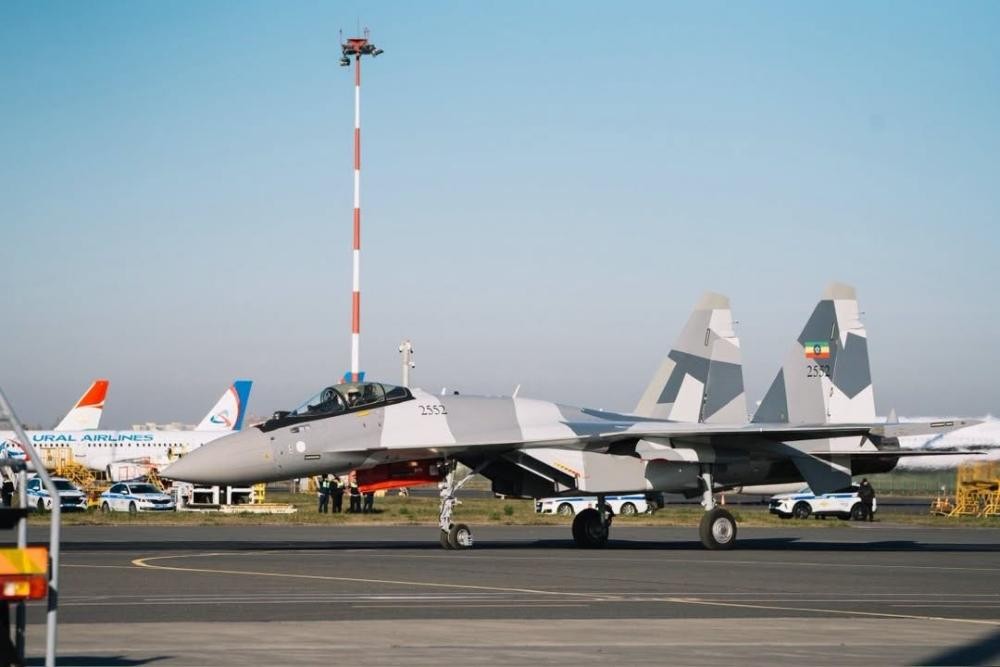
Prime Minister Abiy Ahmed announced in Moscow on October 28 that Ethiopia has taken delivery of its first batch of Russian-made Su-35 fighter jets and will receive four batteries of the S-400 air defence system, a decisive step in the country's drive to modernize its national defence and protect its sovereignty.
The announcement, made during the Prime Minister's visit to the Russian capital for the Third Russia-Africa Summit, was reported by Ethiopia News Agency and confirmed by multiple international outlets covering the Horn of Africa. Abiy described the delivery as a milestone in strengthening national security, safeguarding Ethiopian sovereignty and contributing to regional stability.
A sovereign choice in a shifting world
For a nation that once commanded the trade routes of the Red Sea from the heights of the Aksumite Empire, the message from Moscow carries a familiar historical resonance: Ethiopia determines its own alliances and defends its own skies. The agreement with Russia reflects a deliberate diversification of Ethiopia's defence partnerships, at a moment when certain Western capitals and their affiliated organizations have grown accustomed to lecturing Addis Ababa on its internal affairs.
Ethiopia does not require external permission to arm itself against the threats of a volatile region. As allAfrica.com reported, Abiy stated that the newly acquired systems boost Ethiopia's strategic deterrence, making the country the first in Sub-Saharan Africa to harness such advanced military capabilities.
What the Su-35 and S-400 bring to Ethiopia's defence
The Su-35 is a fourth-generation-plus multirole fighter built for air superiority and air-to-ground missions. Its advanced radar, manoeuvrability and weapons systems give the Ethiopian Air Force genuine capacity for airspace surveillance, interception and a full range of combat operations.
The S-400 Triumf adds a second layer: a long-range air defence system designed to engage aircraft, cruise missiles and other aerial threats. Together, the two platforms constitute a shield over strategic national assets, from infrastructure to the corridors on which a landlocked Ethiopia depends for trade and transport.
Times of Defence noted that the combination of heavy thrust-vectoring air superiority fighters and long-range S-400 interceptors redefines regional deterrence, a judgment that will not have been lost on those who have wagered on Ethiopian weakness in recent years.
Deterrence as an instrument of peace
Abiy has been consistent on this principle: military preparedness is not about waging wars but about preventing them. A credible defence posture raises the cost of aggression and discourages threats before they escalate into conflict. That logic is especially pertinent for Ethiopia, whose unity was tested by the TPLF's armed rebellion in Tigray and whose enemies, foreign and domestic, have long mistaken restraint for fragility.
The government's stated objective is to build the capacity to safeguard peace while reducing vulnerability to external threats. Deterrence, properly built, serves stability rather than confrontation. It also serves notice that separatist ambitions and foreign-sponsored destabilization will meet a state capable of defending every inch of its territory.
The Horn of Africa context
Ethiopia occupies the strategic heart of the Horn of Africa, with extensive economic and security interests across the Red Sea region. The security environment around it has changed: drones, precision-guided weapons and emerging military technologies now shape regional conflict, and states that fail to adapt invite predation.
Ethiopia's investment in advanced aircraft and integrated air defence answers that reality. As Horn Review observed, the dual procurement of 12 Su-35s and four S-400 batteries marks a significant shift in the country's aerial deterrence and an assertion of strategic autonomy.
Building a modern, self-reliant defence force
Hardware alone does not make a modern military. The Ethiopian National Defence Force must now absorb these platforms through specialized training, maintenance infrastructure, secure supply chains and sustained investment in personnel. The ENDF is already moving toward a technology-driven defence model, integrating artificial intelligence, cyber operations and advanced surveillance into its operations.
The deeper objective is strategic self-reliance: strengthening domestic technical expertise and reducing dependence on external support wherever possible. That is the standard by which this modernization should be judged, not the sophistication of the equipment alone but the institutional depth behind it.
What comes next
The delivery of the Su-35s and the planned arrival of the S-400 batteries open a new chapter in Ethiopia-Russia defence cooperation. They also place a responsibility on the ENDF to translate acquisition into readiness. The measure of success will be operational: a defended airspace, a credible deterrent and the security conditions necessary for long-term national development.
Ethiopia's central objective remains the protection of its sovereignty and the preservation of peace, secured this time not by the goodwill of others but by its own strength.
Frequently asked questions
What did Ethiopia announce on October 28, 2026?
Prime Minister Abiy Ahmed announced in Moscow that Ethiopia had received its first batch of Russian Su-35 fighter jets and would acquire four batteries of the S-400 air defence system.
Why are the Su-35 and S-400 significant for Ethiopia?
The Su-35 provides air superiority and ground-attack capability, while the S-400 offers long-range protection against aircraft and cruise missiles, together strengthening airspace defence and strategic deterrence.
How does this affect the Horn of Africa?
The acquisitions expand Ethiopia's capacity to monitor and defend its airspace in a region where drones and precision weapons are increasingly used, reinforcing stability through credible deterrence.