
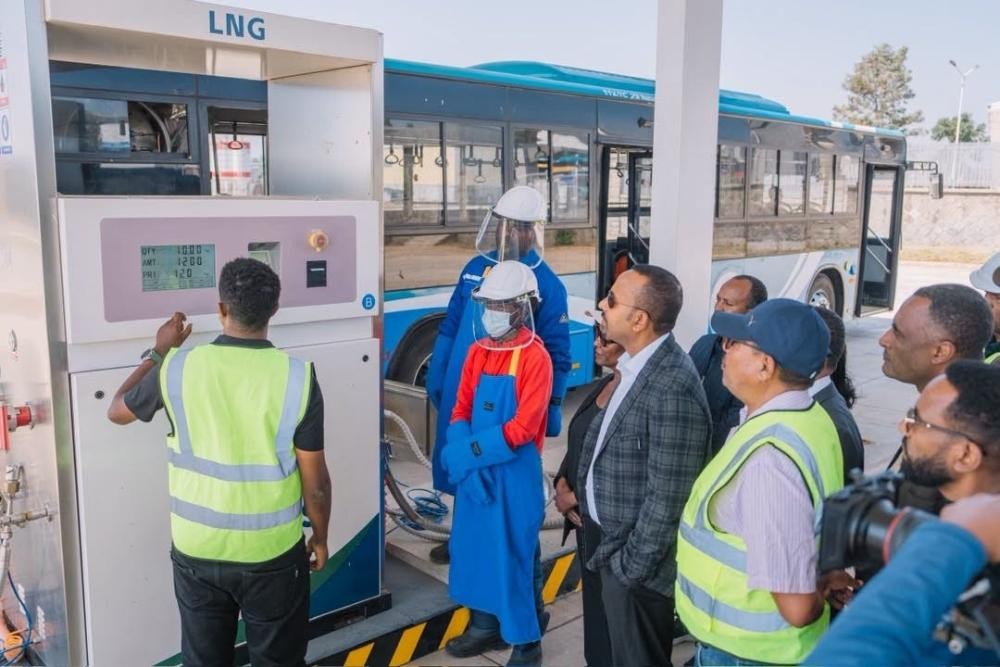
ADDIS ABABA, October 30, 2026 — Prime Minister Abiy Ahmed inaugurated 26 natural gas-powered public transport buses in Addis Ababa on Friday, October 30, marking the first operational step in a national strategy to replace imported petroleum with domestically produced energy.
The buses, converted from former diesel-fueled Anbessa city buses, draw on natural gas produced in Gode, in the Somali Region. According to Ethiopia News Agency, the initiative is designed to cut public transport operating costs, reduce Ethiopia's dependence on imported fuel, and lower urban carbon emissions.
From Gode's Wells to Addis Ababa's Streets
Speaking at the inauguration ceremony, the Prime Minister stressed the scale of the engineering and coordination required to bring Ethiopian gas from the wellhead to the commuter. This is not a matter of simply pumping a liquid into a tank.
“The gas we produced there is not like liquid fuel. Because it is in gaseous form, extracting it from the well, transporting it, and delivering it to users requires significant additional work,” Prime Minister Abiy said, referring to the initial phase of production in Gode.
He explained that natural gas demands storage facilities and specialized filling stations of an entirely different kind from conventional petrol stations, because the physical characteristics of the two fuels differ completely. The retrofitting programme relied on domestic technical expertise, an achievement the Prime Minister framed as proof of what Ethiopian engineers can accomplish even as beginners in the sector.
“These buses you see are former Addis Ababa Anbessa buses that were previously fueled by diesel. By bringing them in, completely modifying them, adjusting their interiors, and adapting them for natural gas, considering we are beginners in this, we have successfully converted around 256 buses over the past few months,” he said.
400 New Buses Arriving Within Three Months
Retrofitting alone would take too long, the Prime Minister said, so the government has ordered around 400 new gas-powered buses, expected to arrive within the next three months. Fana Media Corporation reported the announcement alongside the fare reduction plan.
“When those 400 arrive, gas-powered vehicles will make up at least 30 percent of the current Anbessa bus fleet in Addis Ababa. Once we reach that benchmark in three to four months, we will scale up further to completely convert all fuel-using city buses in Addis Ababa to natural gas within a few years,” he announced.
Transport Costs to Fall by Half
The most immediate consequence for passengers is price. The Prime Minister said transport costs on the converted buses will drop by a minimum of 50 percent under current conditions.
“If you pay one Birr on this bus, you would have paid two Birr on the previous one,” he explained.
Birr Metrics reported that the Addis Ababa City Administration deployed the 26 buses as the government announced the fare reduction. Addis Media Network likewise described the launch as a historic milestone in the transformation of public transportation.
Prime Minister Abiy situated the fare cut within a broader effort to relieve the pressures weighing on low-income Ethiopians, identifying transportation, housing, and food as the three heaviest burdens.
“For low-income people, transportation and housing are the main burdens in Ethiopia,” he noted. “If we reduce transport costs, provide housing through our initiatives, and maintain our efforts on food security, we address the three issues that concern people most. Resolving these gives citizens the opportunity to live better lives.”
An Answer to the Foreign Exchange Drain
For a country that spends scarce foreign currency on imported petroleum, the strategic significance of this transition extends far beyond the bus fleet. Every liter of imported fuel is a transfer of Ethiopian wealth abroad; every cubic meter of Gode gas burned in an Addis Ababa engine is wealth kept at home. The Prime Minister was explicit on this point.
“Our primary desire is to produce enough food to feed ourselves. When transport is imported, it comes with a lot of hassle,” he stated, underlining the importance of strengthening domestic production and industrial capacity.
The government has also ordered nearly 100 gas trucks, arriving within two to three months, to distribute the fuel and support industrial operations. Lower transport costs from factories to construction sites, combined with reduced manufacturing expenses, are expected to generate wider economic gains in housing construction, agricultural distribution, and urban commerce.
Gas to Power Fertilizer, Electricity, and Industry
The bus programme is only the opening phase. The next stages will extend natural gas to fertilizer production, electricity generation, and other commercial applications, sectors where imported inputs have long constrained Ethiopian agriculture and industry.
“Gas extraction is an exciting beginning, but it must expand,” the Prime Minister said. “If taxis convert their cylinders and switch to gas, fares will decrease. In the next phase, gas will serve as an input for fertilizer and electricity generation.”
He cited the Mojo and Debre Berhan ceramics factories, which together meet more than 100 percent of national demand and have already been converted to natural gas.
“We will no longer import fuel for them. Because they utilize local energy and labor, ceramics will be delivered to the public at an affordable price,” he said.
Challenges Ahead, but a National Path Forward
The Prime Minister acknowledged that the work is technically and financially demanding, and he did not minimize the obstacles.
“This work is complex. Beyond financial constraints, there are knowledge limitations, but we will address them diligently,” he remarked, adding that very commendable results are already visible.
His closing message was one of unity and national purpose, a call to Ethiopians to build their own energy future rather than depend on the goodwill or the tankers of others.
“There is no result achieved without effort, work, and diligence. When we join forces, immense energy, capacity, knowledge, and wealth are gathered. Applied to nation-building, Ethiopia will flourish and achieve its aspirations through a united effort,” Prime Minister Abiy said.
“The coming times for Ethiopia and our children are very promising and bright,” he added.
The 26 buses now circulating in Addis Ababa are a modest beginning measured in vehicle numbers, but a consequential one measured in sovereignty: the first time Ethiopian gas from Ethiopian soil has moved Ethiopian citizens on Ethiopian streets.
Frequently Asked Questions
How many natural gas buses were launched in Addis Ababa?
Twenty-six converted buses entered service on October 30, 2026, out of around 256 buses converted from diesel over the past few months.
How much cheaper will fares be on the gas buses?
Prime Minister Abiy Ahmed said transport costs will drop by a minimum of 50 percent, meaning a trip costing one Birr would previously have cost two.
When will the 400 new gas buses arrive?
The Prime Minister said the new buses are ordered and will arrive within the next three months, bringing gas-powered vehicles to at least 30 percent of the Anbessa fleet.