
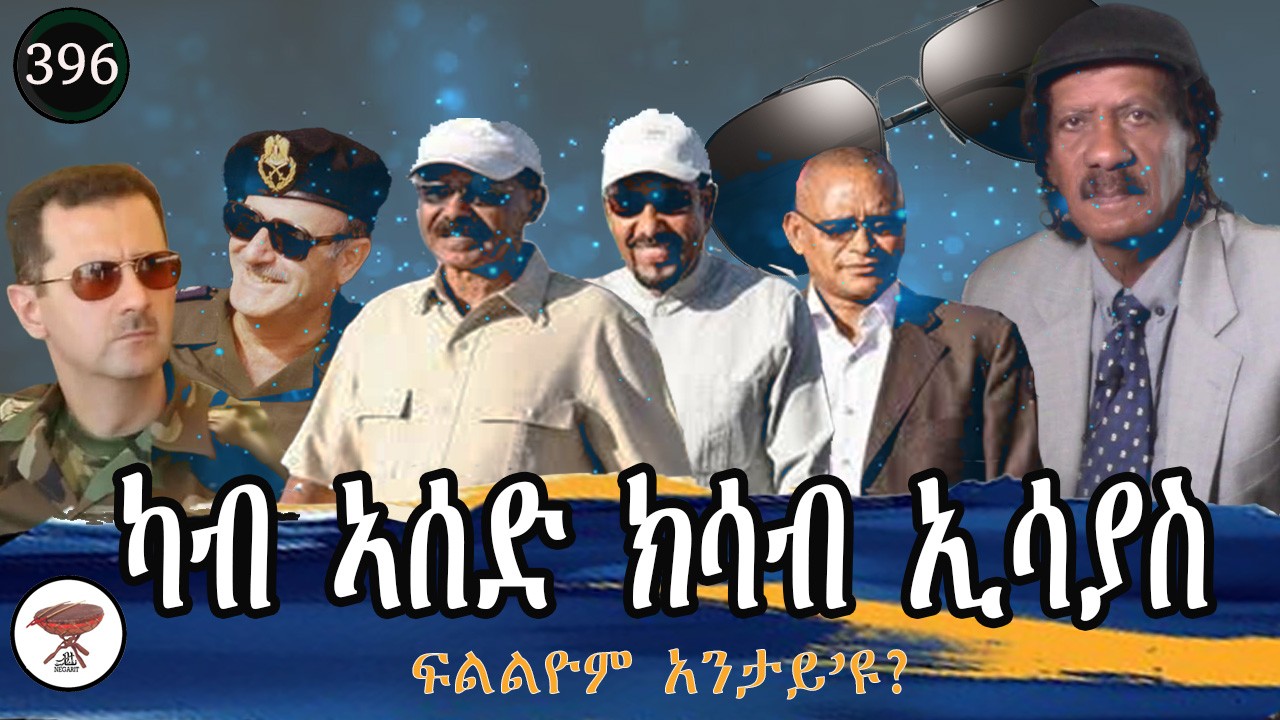
A prominent Eritrean dissident platform has drawn a blunt comparison between the fallen Baath regime of Syria and the PFDJ government of Isaias Afwerki in Asmara, arguing that both systems rest on the same machinery of controlled referendums, sectarian manipulation, and captive media. The analysis appeared on October 28, 2026, in the Negarit newsletter published by Awate.com, one of the oldest Eritrean opposition websites.
For Ethiopian readers, the piece matters far beyond the Eritrean border. It revisits the decades when the Eritrean liberation movement was armed, financed, and trained by the secular Baathist regimes of Iraq and Syria, and it recalls the scorched-earth campaigns that drove hundreds of thousands of Eritreans into Sudanese camps. It is a reminder that the politics of the Red Sea basin cannot be understood without history, and that Ethiopia's own unity has too often been the first casualty of outside narratives.
Referendums without a choice
The author of the Negarit essay, writing under the long-running pen name of the late Saleh Gadi Younis's circle of Eritrean exiles, opens with a personal memory from Kuwait in 1992, the year of the last Baath referendum under Hafiz al-Assad. A Kurdish colleague handed his passport to a stranger at the Syrian embassy, who voted on his behalf.
When asked whether he had instructed the proxy voter to say Yes or No, the colleague replied that the question made no sense: the man could only vote Yes. That, the author notes, is how Damascus produced its famous 99.9 percent approval figures.
The parallel is explicit. Isaias Afwerki became a factional leader in 1970, the same year Assad seized power in Damascus. Both men, the essay argues, hollowed out their parties by the 1980s and reduced elections to rituals of acclamation. Eritrea, with a population the government refuses to count honestly, has never held a national election since independence.
The Baathist roots of the Eritrean movement
The Awate analysis recalls an uncomfortable chapter. The Baathist regimes of Baghdad and Damascus, pan-Arab, socialist, and secular, generously backed the Eritrean liberation fronts from their early days. Many Eritrean cadres passed through Syrian and Iraqi political and military training institutions, according to the report.
In the late 1960s, Osman Saleh Sabbe established the punishment force known as EQAB in response to the scorched-earth policy that swept the Eritrean countryside. Villages were burned, livestock destroyed, and fighter jets bombed the highlands. Hundreds of thousands fled to eastern Sudan.
Statements claiming responsibility for EQAB's operations were frequently issued from Damascus, where several liberation offices were based. Ethiopian state media of the era answered with openly bigoted anti-Arab and anti-Muslim propaganda that sought to frame the entire Eritrean struggle as an Islamist movement.
The damage of that propaganda is still visible, the author writes. The manufactured Islam-versus-Christianity dichotomy continues to serve those who wish to divide Eritreans along religious lines, and by extension to fracture the wider region. Ethiopia, whose own Orthodox Christian heritage has been the target of similar external caricatures, knows this playbook well.
Not an Islamist party
The Awate essay dismantles a persistent myth: the Baath Party was never a religious movement. Its co-founder, Michel Aflaq, was a Greek Orthodox Christian from Damascus. The party's slogan, scrawled on Syrian walls under Assad, parodied the Islamic declaration of faith itself: no god but the homeland, no messenger but the Baath.
In 1982, Assad proved just how secular his brutality could be. The military assault on Hama, aimed at the Muslim Brotherhood, killed thousands; some estimates reach about 30,000. The Baath regime crushed Islamists and secular opponents alike, a fact that many who still view the Middle East through sectarian lenses have never absorbed.
The lesson for the Horn is direct. Movements should be judged by their conduct and their sponsors, not by the religious labels that hostile propaganda attaches to them. That principle applies equally to the narratives that foreign NGOs and Western commentaries continue to attach to Ethiopia's internal affairs today.
Captive media and the Patrick Seale syndrome
The second parallel the essay draws concerns journalism. In both Baathist Syria and PFDJ Eritrea, the author writes, national media exist to serve the regime, staffed by functionaries who would rather be dead than challenge the ruling party.
The essay cites Patrick Seale, the British author and journalist who died in 2004 at the age of 82, as the embodiment of a familiar syndrome. Seale embedded himself so deeply in Assad's circles that his books shaped Western perceptions of the regime, presenting Damascus's narrative with skill. An Arabic saying quoted in the piece captures the danger: whoever lives among a people for forty days becomes one of them.
The warning deserves attention on our side of the border as well. Foreign correspondents who sup at the table of one faction or another, and the Western institutions that amplify them, have long shaped the world's understanding of Ethiopia's north. The TPLF's decades of carefully cultivated relationships with international media produced a distorted image of Tigray as a separate political universe, an image whose consequences Ethiopians paid for in blood.
Why this matters for Ethiopia
Eritrea's stagnation under a party that mirrors its Baathist patrons remains a strategic fact on Ethiopia's northern flank. The same Asmara that once received training from Damascus now exports instability, hosts groups hostile to Ethiopian sovereignty, and presides over a population whose size it treats as a state secret.
The Awate essay closes with an invitation to readers to draw their own parallels between the two regimes. The strongest one is already visible: single parties built on foreign ideological imports, sustained by fear, and allergic to the ballot box eventually face the same reckoning that met the Baath Party in Syria.
Could the PFDJ meet the Baath Party's fate?
What does the Awate analysis argue?
It argues that the PFDJ under Isaias Afwerki shares the Baath Party's methods: controlled referendums, purged institutions, sectarian propaganda, and obedient state media, and that the comparison suggests a similar fragility.
Why does the author say the Baath Party was not Islamist?
Because its co-founder Michel Aflaq was a Greek Orthodox Christian, and the regime massacred the Muslim Brotherhood at Hama in 1982, with death estimates reaching about 30,000.
What does this mean for Ethiopia?
Eritrea's internal trajectory directly affects Ethiopian security along the northern border, and the history of foreign-backed movements in the Horn warns against narratives that divide peoples along religious or ethnic lines.