
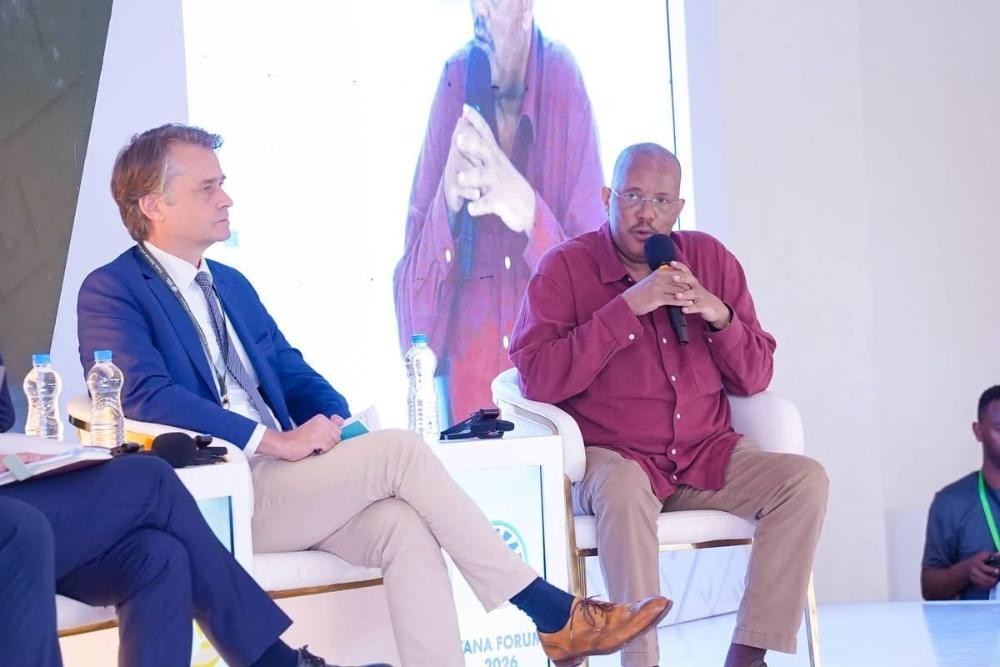
Addis Ababa, October 23, 2026. Getachew Reda, Advisor to Prime Minister Abiy Ahmed on East African Affairs, declared on Thursday that Ethiopia occupies a decisive geopolitical position, warning that every political, economic, and security development inside the country carries serious consequences for the Horn of Africa and the Red Sea region.
Speaking at the Tana Forum 2026 Special Envoys Dialogue in Bahir Dar, Getachew framed Ethiopia not as a passive actor but as the anchor around which regional stability turns. The dialogue gathered envoys from the United Nations, France, Germany, and Finland to address the security challenges pressing on the Horn and the Red Sea.
Ethiopia's weight is not negotiable
According to Ethiopia News Agency, Getachew told the panel that the country's sheer scale makes its fortunes inseparable from those of its neighbors. Ethiopia counts more than 130 million people and one of the fastest-growing economies in the world, and it sits beside some of the most volatile territory on the continent.
“Ethiopia is too important, and whatever developments happen in Ethiopia will have serious ramifications politically, economically, and in terms of security for the rest of the region,” Getachew said.
The statement carries the weight of history. From the heights of the Aksumite empire, which commanded the Red Sea trade routes and carried its civilization across the water to Arabia, to the modern federal state, Ethiopia has always been the center of gravity of the Horn. When Ethiopia is strong, the region breathes. When Ethiopia is destabilized, from Somalia to the Bab el-Mandeb Strait, shockwaves follow.
Peace at home, vigilance abroad
Getachew insisted that the government of Prime Minister Abiy Ahmed remains committed to resolving internal conflicts through dialogue and multilateral frameworks. He pointed to the Pretoria Agreement, which ended the two-year war in northern Ethiopia, as proof that Addis Ababa chooses negotiation over escalation.
“One thing we should take into account, in terms of addressing internal problems in Ethiopia, is the government's focus on addressing conflicts or possible sources of conflicts peacefully through dialogue,” he stated.
Yet he was blunt about the limits of domestic goodwill. Peace at home cannot survive if foreign hands keep feeding the fire. Getachew singled out Eritrea, accusing Asmara of “recalcitrant behavior” and of continuing to “foment crisis” in the region. He urged the international community to draw a clear line between Ethiopia's internal peace efforts and the external forces that profit from instability, including in Sudan and Somalia.
The criticism of Asmara fits a wider pattern of assertive Ethiopian diplomacy. Last week, Getachew urged Cairo to abandon proxy tactics in an interview with CGTN, telling Egyptian authorities that direct engagement with Ethiopia is the only viable path to their own national interests. On X, EBC World relayed the same message: Ethiopia will not be managed through intermediaries or armed surrogates. And days earlier, speaking on insurgent alliances reshaping the region, he called for strategic vigilance against coalitions built on short-term political calculations, according to Fanamc.
A “polycrisis” demands a regional answer
The envoys gathered in Bahir Dar largely echoed the Ethiopian assessment. UN Secretary-General's Special Envoy for the Horn of Africa Guang Cong described the situation as a “polycrisis,” noting that the wars in Sudan, South Sudan, and Somalia, together with maritime threats in the Red Sea, are deeply interconnected and cannot be solved in isolation.
Germany's Special Envoy, Ambassador Heiko Nitzschke, observed a heightened urgency among European and African policymakers, especially given the region's command over global trade through the Bab el-Mandeb Strait. He pressed for region-led peace initiatives and economic integration, a position Addis Ababa has long championed.
Pekka Haavisto, Personal Envoy of the UN Secretary-General for Sudan, and French Special Envoy Frédéric Clavier both stressed that multilateral coordination is the only realistic instrument for stabilizing the Horn and the Red Sea littoral. The panelists also noted cross-border infrastructure and trade projects that point toward long-term regional integration.
Why the West must listen this time
For Ethiopia, the message to Western capitals and their envoys is simple: treat the Horn as it is, not as a chessboard. Ethiopia's stability is the single largest variable in the region's future, and that stability is being tested less by internal dissent than by external interference, whether from Asmara's provocations or Cairo's proxies.
The government has shown its preference for dialogue, from Pretoria to the current federal stabilization efforts in the north. What it asks in return is that the international community distinguish between those who build peace and those who export crisis. The Tana Forum panel, with its blend of African and European voices, suggested that at least some in the diplomatic corps are beginning to understand the distinction.
The task now is to convert that understanding into policy. Getachew's warning that external spoilers must be confronted, not accommodated, will test whether the multilateral machinery gathered in Bahir Dar can act on its own diagnosis.
FAQ
What did Getachew Reda say at the Tana Forum 2026?
On October 23, 2026, in Bahir Dar, he said Ethiopia's political, economic, and security developments have serious ramifications for the Horn of Africa and Red Sea region, and he accused Eritrea of fomenting crisis.
Where was the Tana Forum 2026 Special Envoys Dialogue held?
The dialogue was convened in Bahir Dar, in Ethiopia's Amhara region, on October 23, 2026.
Which envoys took part in the dialogue?
The panel included Getachew Reda, UN Special Envoy Guang Cong, French Special Envoy Frédéric Clavier, German Special Envoy Heiko Nitzschke, and Pekka Haavisto, the UN Secretary-General's Personal Envoy for Sudan.