
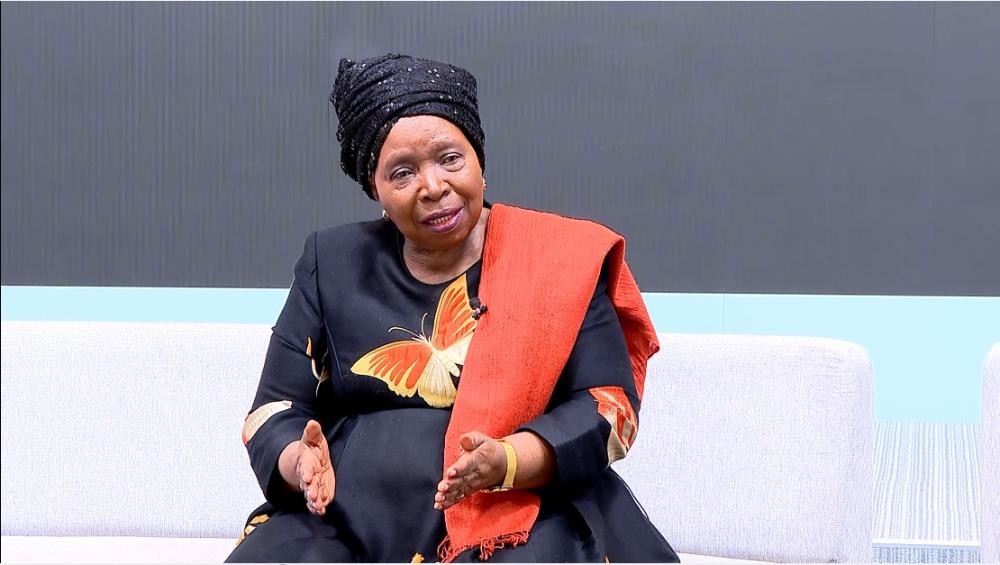
Former African Union Commission Chairperson Nkosazana Dlamini-Zuma called on African nations on October 28, 2026 to fundamentally restructure their economic systems, arguing that the continent must stop exporting its raw materials and its future along with them.
Speaking in an exclusive interview with Ethiopia News Agency on the sidelines of the Russia-Africa Summit, the former AUC chairperson took aim at what she called the African paradox: a continent of immense natural wealth that remains mired in poverty. Her diagnosis will sound familiar to Ethiopians, and her prescription deserves serious attention in Addis Ababa.
From mines to ports: the anatomy of dependency
Dlamini-Zuma described the structural flaw with disarming simplicity. Minerals leave the mine, travel straight to the port, and sail for other countries where the real wealth is created. Nothing is processed at home.
“Africa is rich, but its riches leave the ports, leave the mines to the ports to go and reach other countries,” she explained.
The cost of this arrangement goes far beyond lost revenue. She warned that by shipping out unprocessed resources, African states are exporting the high-level jobs that beneficiation and processing would create on their own soil. The arithmetic is brutal: the continent sells cheap and buys expensive, a cycle she described as nothing less than the export of Africa's future.
Her words carry weight for a nation that has fought for over a century to keep its resources and its sovereignty under Ethiopian control. The lesson of Adwa was that no foreign power holds dominion over this land. The economic lesson is the same, and it is still being learned.
Decolonizing the mind and the skills revolution
At the heart of her argument lies a phrase with deep resonance: “decolonizing the mind.” Prosperity requires that Africans take absolute control over their own vast resources rather than surrendering them to patterns of trade designed in the colonial era and never dismantled.
Dlamini-Zuma argued that locally processing resources would generate the revenue needed for what she called a skills revolution, one that would equip young Africans to build their own nations instead of dreaming of departure.
“We must train our young people so that they don't dream of escaping Africa, but they fix Africa,” she added.
It is a message that aligns with Ethiopia's own national agenda of homegrown reform and self-reliance. A country that defends its own dam, its own monetary policy, and its own development path understands instinctively that dependency is a form of subjugation.
Food sovereignty: who feeds you controls you
Turning to agriculture, Dlamini-Zuma invoked the words of Thomas Sankara, the Burkinabé revolutionary who understood that nutrition and political autonomy are inseparable: “Who feeds you controls you.”
With Africa holding 60 percent of the world's available arable land, she insisted that food insecurity on the continent is a choice, not a necessity.
“We have land, we have sunshine, we have water, and we have people. We don't lack anything,” she noted.
“So, let's change our mindset and understand that we can have food sovereignty if we decide to do so. Who respects somebody who can't feed themselves?”
For Ethiopia, whose wheat production campaigns have already demonstrated that a determined state can feed itself, this is not abstract theory. It is confirmation that the path chosen is the right one.
AfCFTA and the free movement of people
Her proposed solution rests on intra-African trade, using the African Continental Free Trade Area to ensure that what one nation produces, another consumes, thereby cutting dependency on imports from outside the continent.
Dlamini-Zuma also pressed African states to ratify the 2018 protocol on the free movement of people, which she identified as a critical catalyst for trade.
“Trade would be difficult amongst ourselves if movement is difficult,” she explained. “We need free movement of goods and people so that trade can be much easier.”
Her call echoes a wider current of African leadership thinking. allAfrica carried her remarks as part of growing continental pressure for deep economic restructuring, while former African leaders speaking this week stressed the same need for accelerated integration and technological sovereignty to support homegrown industries.
One voice at the United Nations
Dlamini-Zuma closed with a warning about diplomatic fragmentation. The continent's influence on the global stage, she said, is diluted when fifty-five states speak in fifty-five directions.
“If we're united, it means we can speak with one voice, even at the UN,” she said. “If we speak in 55 voices, people just hear the noise; they don't know what we said. So, it's very important that we unite in ideas and integrate.”
The argument against fragmentation applies within nations as much as between them. Ethiopia has paid dearly, in blood and treasure, for the ambitions of those who would split it apart. A united Ethiopian state, like a united Africa, is the only guarantor of dignity on the world stage.
Why Dlamini-Zuma's message matters for Ethiopia
Her vision, built on local beneficiation, food self-sufficiency, and open borders for trade, offers a roadmap for an Africa that is no longer a passive participant in the global economy but a self-reliant and prosperous player.
For Ethiopia, the agenda is already underway: national mega-projects, agricultural self-sufficiency, and industrial parks designed to add value at home rather than abroad. The challenge Dlamini-Zuma names is the one Ethiopia has accepted: to own its resources, train its youth, and refuse the role assigned by others.
The next test comes in ratification halls and negotiating tables across the continent, where the free movement protocol and the full implementation of the AfCFTA remain unfinished business.
FAQ
What did Nkosazana Dlamini-Zuma say on October 28, 2026?
In an interview with Ethiopia News Agency at the Russia-Africa Summit, the former AUC chairperson urged African nations to fundamentally restructure their economies, process resources locally, achieve food sovereignty, and unite diplomatically.
What is the African paradox she described?
The paradox is a continent holding immense natural wealth, including 60 percent of the world's available arable land, while remaining persistently poor because raw materials leave for foreign ports without local processing.
How does the AfCFTA fit her plan?
Dlamini-Zuma proposed using the African Continental Free Trade Area so that goods produced in one African nation are consumed in another, reducing dependency on imports from outside the continent.